
Executive Summary
AI has made its way into the financial sector but in many cases, its contribution to operational excellence still falls short of expectations. The reasons are rarely technological. Instead, the challenges often lie in the lack of structure, insufficient process maturity, and vague objectives. To realize meaningful impact, organizations must first understand where AI truly adds value, and where it doesn't.
This whitepaper introduces a practical framework for assessing where AI is most effective. It groups processes into four categories: high-volume customer interactions, internal standardized workflows, regulated reporting, and expert-driven tasks. These process types differ significantly in maturity, standardization, regulatory exposure, and AI potential — and these differences are key to prioritizing AI initiatives effectively.
The core principle is to optimize processes before integrating AI. Technology can only deliver value when processes are stable and data-driven. This whitepaper outlines a structured approach from current state assessment to use case selection and step-by-step implementation through pilot, scale-up, and integration. This is not about chasing the next hype. It's about substance, impact, and control.
1. Introduction: AI is here to stay, yet its real-world impact frequently lags behind expectations
AI is no longer a future trend. Many organizations already use models to generate text, analyze documents, respond to inquiries, or support operational decisions. What once seemed experimental is now technically mature and widely accessible. And yet, the practical benefits of AI still frequently fall short of expectations. The issue is rarely technical. More often, it stems from vague goals, low process maturity, or limited adoption beyond initial pilots.
AI only delivers value where structure exists — where processes are stable, information is accessible, and responsibilities are clearly defined. What many organizations lack is not the willingness to innovate, but a systematic approach and internal guidance for applying AI. The real question isn't "where could AI theoretically be used?" but rather "in which real-world settings can AI deliver tangible impact?"
This whitepaper provides a clear answer. It introduces a method for categorizing processes by key criteria: frequency, standardization, regulatory pressure, and knowledge intensity. These factors determine whether AI should automate, assist, or be avoided entirely. The message is clear: operational excellence isn't achieved through technology alone — but through focused prioritization. Without process logic, AI increases complexity, not quality.
2. AI as a Catalyst for Operational Excellence: Technologies, Applications, and Preconditions
AI provides multiple levers to optimize operations. It supports or makes decisions, detects patterns in large datasets, and enables personalized customer interactions. This leads not only to faster processes but also to greater structure — especially critical in an environment of rising regulatory demands and customer expectations.
AI technologies fall into several partially overlapping categories:
- Machine Learning (ML) underpins prediction, classification, and data-driven decisions.
- Natural Language Processing (NLP) analyzes unstructured language in emails, contracts, or regulatory documents.
- Computer Vision analyzes and processes visual information in images or videos.
- Generative AI creates content such as text, images, or code and is particularly useful in knowledge-intensive environments.
- Reinforcement Learning (RL) is suitable for dynamic, feedback-driven decision-making in complex systems.
- Predictive Analytics anticipates process behaviors, customer responses, or operational risks based on existing data.
In consulting work with banks and insurance companies, the breadth of potential AI applications is already clearly visible: intelligent chatbots handle simple customer service inquiries around the clock, AI models automatically classify incoming cases enabling straight-through processing, and back-office systems check documents for completeness, extract relevant data, and perform reconciliations. AI is also being applied in risk management — for example, to detect suspicious transaction patterns or to support KYC processes.
However, AI is not plug-and-play. It requires defined processes, structured and high-quality data, as well as organizational readiness. Technology alone is not enough. A holistic approach is needed — one that systematically aligns AI with strategic goals and operational realities.
3. Where AI Has the Greatest Impact: Using Process Logic to Prioritize
Not every process offers the same value for AI adoption. High potential lies where benefits are high and implementation effort is manageable — where automation is low-risk and delivers clear returns.
Key characteristics include process frequency, standardization, data availability, dependency on experts, and regulatory relevance. Where processes are frequent, rule-based, and data-rich, AI can be deployed quickly and productively. Conversely, irregular, knowledge-heavy, or regulation-sensitive processes pose greater challenges — not just technically, but also in terms of governance, transparency, and trust.
In practice, organizations are often uncertain about how to approach the introduction of AI. A common question is whether it makes sense to start with complex processes even when their structures are not yet stable or sufficiently transparent. At the same time, AI initiatives are sometimes planned without a clear link to business value. That's why a clear prioritization framework is needed to systematically identify the 'low-hanging fruit'.
4. Process Categories at a Glance: Think in Categories, Prioritize Strategically
A one-size-fits-all AI strategy doesn't work. A helpful framework is the classification into four common process categories — they vary widely in their readiness for AI and provide a basis for strategic prioritization:
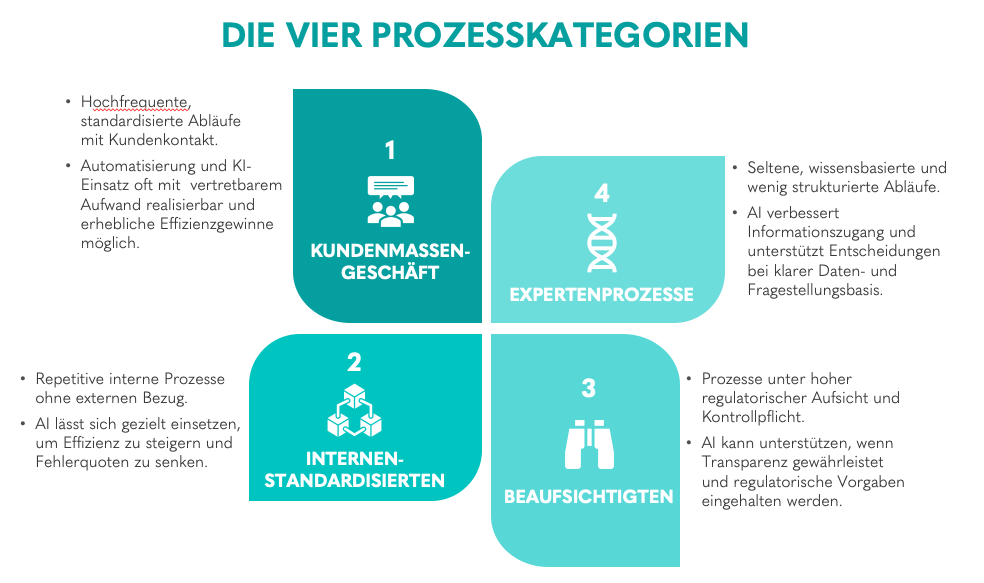
High-Volume Customer Interaction
Standardized, high-frequency processes with direct customer contact — claims handling, application workflows, basic service inquiries. Particularly well-suited for productive AI deployment: chatbots, NLP, ML-based straight-through processing, recommendation engines, and agent-based systems.
Internal Standardized Processes
Structured, managed workflows without direct external interaction — IT services, HR operations. AI contributes to increased efficiency: ticket classification, automated text generation, predictive dashboards, and 'ask-your-policy' large language model applications.
Regulated Processes
High regulatory relevance and low frequency — annual financial statements, risk reporting. Compliance and content accuracy are top priorities. AI can provide selective support for anomaly detection and automated report preparation, always within a human-in-the-loop approach. (FINMA Supervisory Communication 08/2024)
Expert-Driven Processes
Knowledge-intensive and infrequent activities — legal, strategy, portfolio planning. Direct automation is difficult but AI can provide targeted support: structuring data, generating summaries, semantic search, and vector-based information retrieval to ease cognitive strain.
5. From Analysis to Implementation: A Step-by-Step Path to Productive AI Use
5.1 Optimize Processes Before Integrating AI
The first principle of effective AI adoption is that technology should follow the process — not the other way around. AI only works where processes are structured, stable, and controllable. That's why every initiative starts with analyzing and, where necessary, improving the target process: eliminate media breaks, feedback loops, unclear ownership, and inefficiencies. It is also important to assess whether significant changes to the process are imminent. Only optimized processes are truly AI-ready.
5.2 Analyze the Process Landscape
Before specific projects are defined, a sound assessment is needed to determine whether — and in what form — the use of AI is appropriate. In some cases, the same goals can be achieved through conventional means: robust interface architectures, rule-based decision logic, RPA, or targeted software enhancements. Modern low-code and no-code platforms also offer wide-ranging process automation options without the complexity of a full AI project.
The decision for or against AI should always be technology-neutral and problem-driven. Implementing an AI model is not a one-time task — it requires ongoing maintenance, monitoring, and potential recalibration. These operational requirements must be weighed against the expected value.
5.3 Define Goals and KPIs to Create Value
Every AI initiative should begin with a clearly defined objective: increased efficiency, improved quality, enhanced customer satisfaction, or reduced regulatory burden. Only when the objective is explicitly formulated can the actual impact be measured. Suitable KPIs may include processing times, completion rates, error rates, follow-up rates, or customer satisfaction scores — collected from the beginning as a baseline measurement. Beyond goal setting, the total cost of ownership must be considered: development, implementation, and ongoing maintenance.
5.4 Choose an Implementation Logic: Validate – Enable – Execute
Validate
Test a narrow, well-defined use case under real-world conditions. The goal is not to build a perfect model, but to validate fundamental assumptions regarding process logic, data availability, and expected outcomes. Proofs of concept act as risk mitigators.
Enable
Extend validated approaches to additional processes, business areas, or channels. Define technical standards, establish governance structures, and ensure reusability. Create a robust foundation for scaling without compromising quality or control.
Execute
Full integration into day-to-day operations: embedding into existing systems, assigning clear responsibilities, implementing a reliable control framework. Success factors include professional change management, targeted training, and transparent communication.
5.5 Establishing Success Factors
AI projects only deliver results when they are organizationally supported, methodologically guided, and implemented with discipline. This requires:
- Ownership within the business units, not just technical project management
- Accessible, structured data that is well understood, properly maintained, and reliable
- Interdisciplinary teams combining domain expertise, data competence, and IT capabilities
- Regular review and adaptation cycles to support learning and keep the solution current
5.6 Avoiding Common Pitfalls
Successful AI initiatives rarely fail due to a lack of technology — but rather due to poor decisions around processes:
- AI applied to unclear, unstable, or unnecessarily complex processes
- Objectives poorly defined, leaving impact unmeasurable
- Data readiness overestimated, leaving models "blind"
- Implementation remaining siloed, preventing scalability
- AI adoption driven by hype rather than business value
- Ethical considerations and regulatory requirements overlooked
- Operations and change management not adequately addressed
6. Conclusion: Operational Excellence Doesn't Require Vision – It Requires Discipline
AI is transforming how organizations think about, design, improve, and manage their processes. But it is neither a self-running engine nor a universal remedy. Its impact only unfolds where structure, clarity, and leadership come together. What is technically feasible is often irrelevant from an operational standpoint if processes are unprepared, data is unusable, and goals are undefined.
The framework presented in this whitepaper outlines the key elements of impactful AI initiatives. At its core is a well-founded prioritization based on strategic relevance, process maturity, and data availability. Ethical and regulatory considerations must also be taken into account — especially in automated or personalized decision-making contexts.
It's not about automating as much as possible — but about automating what truly matters. Not about introducing new technologies — but about meaningfully advancing existing structures. Only when technology meets clarity does real progress happen. And only when implementation is structured does potential turn into tangible value.
Sources
- Boston Consulting Group, AI Adoption in 2024: 74% of Companies Struggle to Achieve and Scale Value, 2024
- OST – Ostschweizer Fachhochschule & Swiss FinTech Innovations, Künstliche Intelligenz in Schweizer Finanzinstituten: Ein skalierbares Framework zur erfolgreichen KI-Implementierung, 2025
- FINMA-Aufsichtsmitteilung 08/2024: Governance und Risikomanagement beim Einsatz von Künstlicher Intelligenz, 18. Dezember 2024